Denmark native and Acacia’s co-founder Benny Mikkelsen was honored to give a plenary talk during the opening ceremony at the 2025 European Conference on Optical Communication (ECOC). In this blog, we’ll summarize the key points of his presentation, titled “Coherent Optics: Powering the Next Decade of Optical Communications.”
We Are in the Coherent Era
Benny discussed how innovations and key milestones over the last 4 decades paved the way to today’s “coherent era” in transport communications. These continued advancements led to breakthroughs in coherent technology such as the ability to transmit terabits per second over a single wavelength and the use of coherent in very small pluggable form factors that plug directly into switches and routers.
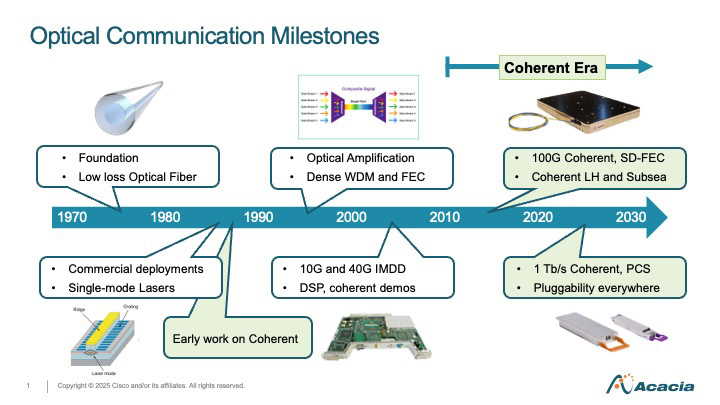 Decades of advancements in optical networking have led to today’s coherent era.
Expanding Use Cases: Over Land, Sea, Space
As Benny explained, the main functions and building blocks of coherent are the same today as they were 15 years ago and will likely be the same 5 years from now. However, what has changed is the type of materials used, the integration of components, the speed/baud rate being used, and what constellation is being leveraged.
As advancements have been made, coherent technology has expanded into new use cases and it is now widely used in long-haul, metro and even access applications. However, the main application for coherent the last two years has been with webscalers interconnecting data centers. This includes 1) connecting data centers in metro-access environments and 2) connecting data centers to data centers in regional, long-haul and submarine networks.
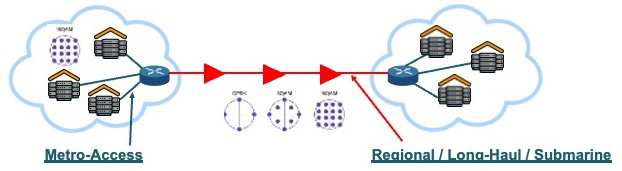 Coherent use cases are expanding into long-haul, metro and access as AI drives capacity demands.
Webscalers have been driving the adoption of coherent pluggables and specifically IP-over-WDM architectures where the pluggables are plugged into the router to deliver significant power, space and cost savings. This architectural shift has also been gaining traction with service providers. Some webscalers are even taking this approach one step further by replacing ROADMs with switches/routers for further power and efficiency gains.
Another exciting application that has emerged for coherent technology is its use in communication links between LEO satellites. They are increasingly used in space today, primarily for connecting satellite to satellite.
Looking Ahead at Trends in Coherent
The industry passed 1T optical carrier in 2022 and is working on 1.6T with 240-260 GBaud. While it has been getting more difficult to increase speed/baud rate, going to higher baud rates is the most efficient way to get the lowest cost per bit. The DSP continues to be the foundation of coherent technology, and the industry still needs to continue coming up with new innovations and algorithms to improve power consumption, latency and compensation for non-linearities. And on the analog side, it will be important to maintain high analog bandwidth on the analog front end.
As Benny discussed, Moore’s law continues and roughly every two years, the industry gets a new node that provides a 30 percent power reduction on the digital part and 10 percent savings on the analog. Today, all commercial systems are based on 3nm DSPs and the industry is working on 1.6T using 2nm DSPs.
On the optics side, today’s modulators are using silicon photonics or indium phosphide. However, looking at the next generation where we need 240 GBaud, the industry may look at thin-film-lithium-niobate (TFLN) because of its higher bandwidth and lower required modulation voltage. We will also need new materials to help speed the optics, advancements in packaging, and ways to reduce the cost of the lasers.
Next Generation Coherent Applications
Coherent continues to expand into new use cases, an example being the new Coherent-Lite for campus applications up to 20km. This enables two data centers to be connected to deliver the combined power needed for demanding next-generation applications such as AI.
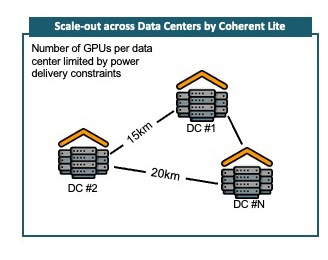 Coherent-Lite enables network operators to scale out across data centers.
Coherent Moving to Shorter Distances
Today, coherent is used between data centers, coherent-lite is moving into the campus, and as data rates continue increasing from 1.6T up to 3.2T and even 6.4T, coherent might even move inside the data center and be co-packaged with switches.
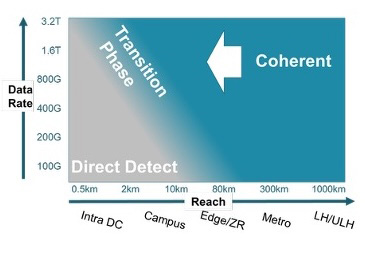 Coherent has continued moving into shorter reaches and will eventually be needed inside the data center.
Benny also touched on some of the new and upcoming coherent applications such as hollow core fiber, access/coherent passive optical network, self homo-dyne detection, and quantum communications and phase sensitive amplifiers.
The Summary
Benny wrapped up his plenary by highlighting what was one of the most widely talked about topics at ECOC, which was how AI is driving huge capacity demands in all areas of the network. For example, 800G ZR/ZR+ coherent pluggables are critical for scale-across AI architectures to connect massive AI clusters across multiple data centers. Coherent is being used everywhere today – over land, water and space – and it’s moving to shorter and shorter distances and to small pluggable form factors.
Over the last ten years, we have seen a fast evolution in coherent performance focused on speed performance, power and cost. The industry is starting to now see challenges on baud rate, fiber capacity and power consumption. However as Benny pointed out in his final remarks, he is confident that the community will continue to push the boundaries of innovation to uncover solutions we have not even imagined yet.
You can watch the full video replay of Benny’s plenary session here.