The success of coherent pluggables has been truly phenomenal, expanding from its original target use case of DCI and into shorter reach campus and access applications as well as long-haul and even subsea.
As the graph from LightCounting illustrates, coherent pluggables continue to grow, but the performance-optimized embedded market is also seeing steady growth. Even though the performance and applications for pluggable coherent modules continue to move closer to those of the performance optimized coherent solutions, there are still some customers that want to use a separate transponder.
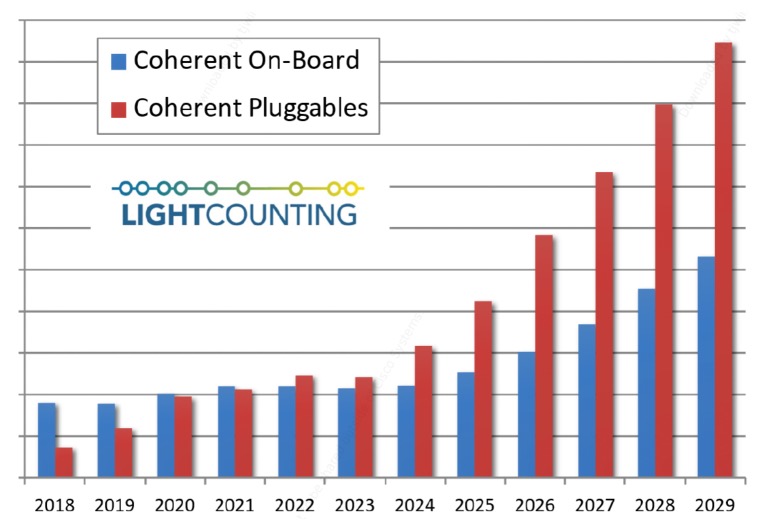 Image 1: LightCounting forecast (2018–2029) comparing the growth of Coherent On-Board and Coherent Pluggable technologies highlights the accelerating market demand for pluggable solutions.
Longer Reaches and Wider Bandwidth
With each new pluggable generation, the applications and capabilities that can be served by pluggables has expanded. Most recently, we saw pluggables going further with the adoption of 400G ultra long haul (ULH) modules and wider with the use of L-band to increase the bandwidth that can be used within the fiber. And, in the future, if a customer needs very high capacity at a short distance, this application could be addressed by coherent lite modules. From DCI all the way to submarine, pluggables are being deployed at a rapid rate across many markets and applications.
Coherent Pluggables for Long Haul
The widespread adoption of coherent pluggables has also been instrumental in driving the growth of IP-over-DWM networks, and this has expanded to long-haul distances. This has brought tremendous benefits to network operators, including:
- Significantly reduced capital and operating expenses by 50% or more
- Simplified IP and optical management since there is no need to change operational practices or tooling
- Reduced space, power and cooling by 70% or more
- Ideal for constrained environments
Service providers now leveraging these advantages are Arelion and Internet2, who both trialed Acacia’s 400G ULH QSFP-DD coherent pluggable for long-haul applications. Arelion achieved a successful IP transmission at a spectrum of 112.5 gigahertz over 2,253 kilometers on its route from Chicago to Denver. Similarly, Internet2 achieved a 400 Gbps link over 3,000 km on the Internet2 national research and education (R&E) network between Albany, New York, and Indianapolis, Indiana.
SDM Opens the Door for Pluggables in Subsea
One of the key technologies enabling operators to use pluggables in submarine networks is Spatial Division Multiplexing (SDM). This technology allows for the simultaneous transmission of a larger number of data streams over different spatial paths within a subsea cable. In practice, this translates to an increased number of optical fibers compared to traditional implementations, which increases the overall capacity of the cable. By providing the following advantages, SDM has opened the door for pluggables to be used in submarine networks:
- With SDM, the signal-to-noise ratio (SNR) per individual fiber is lower. Thus, there is no need to support high spectral efficiency modes (32-QAM, 64-QAM) or high resolution data processing.
- SDM is typically power limited and uses lower launch power, which in turn produces less nonlinear effects. As a result, nonlinearity compensation is no longer necessary or can be simplified.
- The addition of more fiber pairs necessitates optimization of available space and power at the endpoints of subsea links.
One example of a provider leveraging coherent pluggables today in submarine cables is AARNet who achieved a 4,600km reach on the Indigo Subsea Cable using Acacia’s 400G ULH pluggable operated at 75GBd.
So, Will Coherent Pluggables Take over Everything?
We believe the market is moving in that direction. There are still many challenges that need to be overcome, particularly in long haul and submarine networks. For example, advanced impairment mitigation still requires more power than might be available in a pluggable form factor. In addition, those advanced features should not degrade the power consumption of the primary (short reach) use cases for pluggables, but DSP blocks can draw 20% to 35% of current even if disabled. The implementation of power islands might be necessary to help alleviate this problem.
Another challenge is that for pluggables to operate over submarine distances the baud rate must be dialed down. Chromatic dispersion scales quadratically with baud rate, which makes it challenging to compensate it at maximum baud rate. On the other hand, fiber capacity and not module capacity, matters in submarine networks. Hence, operators might be willing to use more wavelengths for the same total capacity.
With the broadest coherent technology portfolio and leading coherent market share, Acacia is committed to continuing to deliver innovative coherent solutions for our customers.