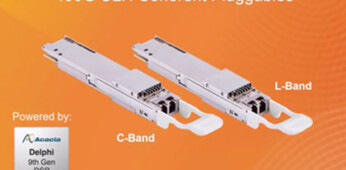
The optics industry has a continuous drive to deliver expanded capabilities, and this is evident with the 400G coherent pluggable evolution. These modules ushered in a cost-saving paradigm that was quickly embraced by hundreds of network operators. And while 400G ZR/ZR+ modules were initially focused on metro and regional reaches, Acacia’s recent introduction of the cutting-edge 400G ultra long haul (ULH) modules now enable network operators to go even further, faster with reaches beyond 3,000km. This capability enables expansion of IP-over-DWDM architectures to long haul, ultra long haul and subsea applications.
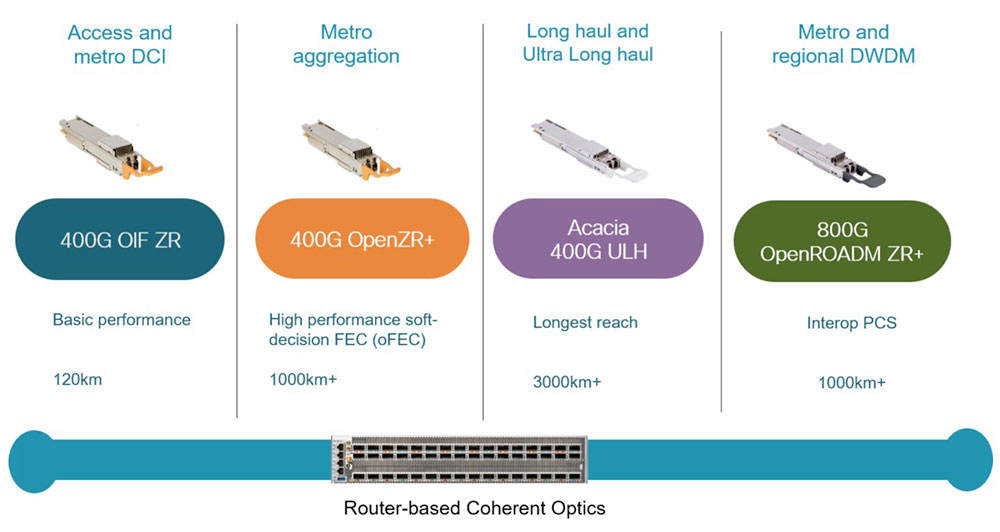 From metro DCI to long haul terrestrial, and even subsea, these pluggables are empowering networks to go further and faster.
GÉANT Sets New Benchmark with 3,403km Reach with Coherent Pluggables
Leveraging Acacia’s 400G ULH module, GÉANT successfully completed a field trial that achieved 3,403 km of terrestrial transmission. Conducted on the GÉANT live production network in June 2025 and using commercially available technology, this trial represents one of the longest known reaches ever demonstrated on a terrestrial network using a 400G QSFP-DD coherent pluggable transceiver with a 24W power envelope, making it compatible with existing 400G-capable routers.
According to Bram Peeters, Chief Network Services Officer for GÉANT, “This significant milestone reaffirms our vision for the GÉANT network. We have been working on making our router and optical platform as open as possible, and now this trial demonstrates the capabilities of high capacity, cost effective, easily deployable pluggable solutions to bridge impressive distances and challenging optical links. These advancements, combined with our recent upgrades, ensure GÉANT is ready for the Terabit era.”
The field trial route consisted of a path through London → Paris → Geneva → Frankfurt → Amsterdam → London, spanning a total of 3,403 km and passing through seven ROADM nodes and 42 in-line amplifier sites. Not too long ago, this distance would have only been possible using traditional stand-alone DWDM transponders.
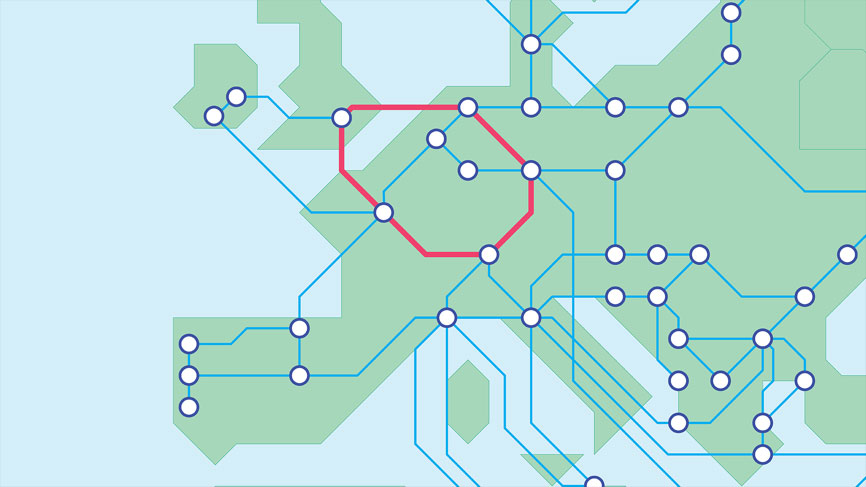 The map above outlines the path of GÉANT’s ultra long-haul route using coherent pluggables. Source: GÉANT
AARNet Achieves 4,600km reach on the Indigo subsea Cable
Traditionally, subsea optical links have been the exclusive domain of highly specialized, dedicated transponder systems leveraging performance optimized coherent modules due to the extreme distances, challenging environmental conditions, and stringent performance requirements. However, the advancements in 400G ULH coherent pluggables are now extending their reach to certain subsea applications.
AARNet (Australia’s Academic and Research Network) achieved a remarkable milestone with the successful completion of a field trial showcasing the capabilities of 400G ULH pluggable coherent optics technology. Conducted over an incredible distance of 4,600km on the Indigo Central subsea cable system, which connects Sydney and Perth, this achievement heralds a new era in subsea optical networking.
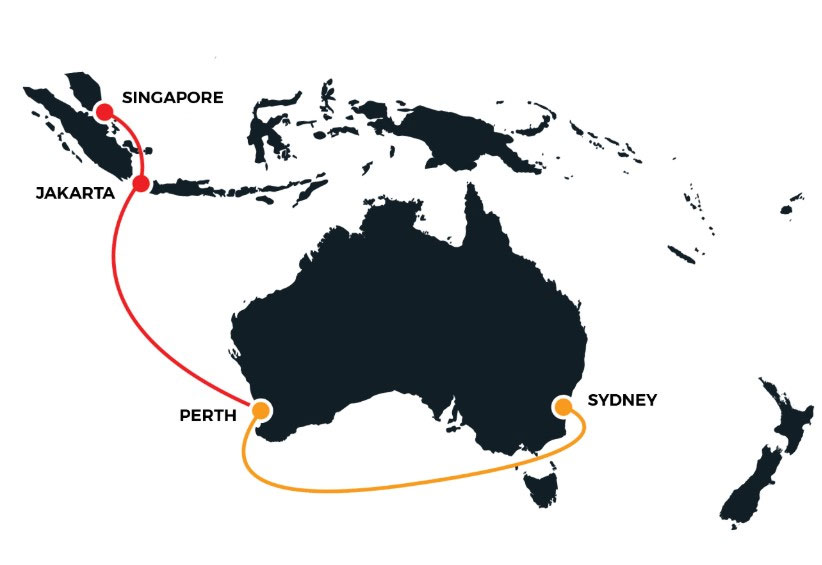 The trial was conducted over an incredible distance of 4,600km on the Indigo Central subsea cable system connecting Sydney to Perth. Source: Offshore Energy
Completed in late May 2025, the trial represented a transformative step forward for Australia’s research and education network infrastructure. By transmitting a 400G wavelength using Acacia’s QSFP-DD ULH coherent module plugged into Cisco’s NCS 1014 3.2 Terabit per second (Tbps) WDM line card, AARNet has advanced what is possible in subsea communication. This trial not only demonstrated the ability to transmit high-speed data over existing submarine cables, but also highlighted the technology’s capacity to enhance network efficiency.
By optimizing the use of available space and power at the endpoints of subsea links, the solution ensures that greater capacity can be achieved without compromising operational performance, reducing power consumption and increasing density to 6.4Tbps per rack unit.
During the trial, the 400Gbps wavelength operated at 75 Gigabaud (GBaud), showcasing the ability to transmit extremely high-speed data efficiently over existing optical infrastructure. This approach enabled better use of the available space and power at the end points of the subsea link without compromising overall capacity of the submarine cable. A major highlight of this trial was the successful operation of this new wavelength in parallel with live traffic on the Indigo Central cable, confirming the technology is ready for immediate deployment and can seamlessly integrate with existing services.
Previously, Arelion and Internet2 also completed 400G ULH trials. Arelion’s live network field trial was completed on its route from Chicago to Denver using the Acacia 400G ULH module at a spectrum of 112.5 gigahertz over 2,253 kilometers. Internet2 achieved a 400 Gbps link over 3,000 km on the Internet2 national research and education (R&E) network. For more details around this trial, read this recent blog.
Advantages of Acacia’s 400G ULH Coherent Modules in IP-Over-DWDM Applications
The Acacia 400G coherent ULH modules are reducing the barrier for network operators to deploy router-based coherent optics in virtually any network scenario. Just a few of the advantages include:
- Significant cost savings (CapEx & OpEx) as they are designed to be deployed in existing 400G slots without needing a hardware upgrade
- Simplified operations, reduced footprint, and power efficiency
- Flexibility to support other host ethernet rates and multiple line rates and scalability enabled by multiple channel spacing options
- Enhanced performance features including high optical transmit output power, built-in tunable optical filter, and C+ L-Band support
Learn more in this video.